Cape Town's Uppers Hold Strong: Why Scarcity Creates Structural Advantage for Overseas Property Investment
Overseas Investment May 31, 2026 8 min read

Cape Town's Uppers Hold Strong: Why Scarcity Creates Structural Advantage for Overseas Property Investment

Bishopscourt prices nearly tripled to R 30M in five years. Cape Town's Uppers defy market gravity through scarcity. R 16,000,000 entry threshold with dual-engine cash flow from day one.

Water Resilience
Property Premium
Dual-Engine Cash Flow
LP
Scott Huang

CEO, DingYao Advisory

Bishopscourt average prices nearly tripled to R 30M in five years. Constantia Upper sits at R 26M. While the broader market slows, Cape Town's "Uppers" defy gravity—not because of economic tailwinds, but because of scarcity. For overseas investors, the R 16,000,000 entry threshold positions you precisely on this scarcity premium curve. Here is how the dual-engine cash flow structure starts working from day one.

Opening: Numbers That Should Not Exist

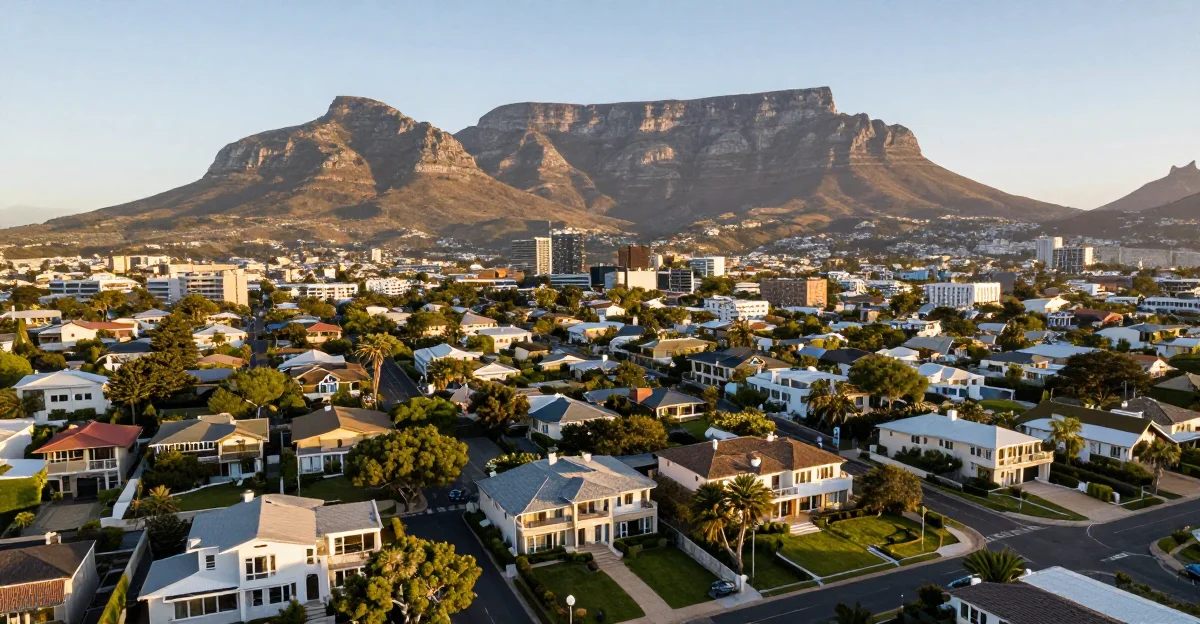
In Q1 2026, South Africa's property market was slowing—higher interest rates, economic uncertainty, fewer buyers across most price bands. Yet across Cape Town's elite Southern Suburbs cluster known as "The Uppers," something counterintuitive happened: transaction volume dropped from 74 to 44 properties year-on-year, but total sales value held almost flat at R 860 million. The average selling price jumped from R 11.7 million to R 19 million.

Francois Venter, Seeff Property Group's lead agent for the Southern Suburbs luxury market, puts it plainly: listings across these premium suburbs have effectively halved compared to a year ago, while buyer competition has not declined proportionally. Sellers are achieving prices within roughly 2% of asking. Average days on market: 32, compared to 41 for the broader market.

These numbers tell one story: The Uppers' resilience is structural, not cyclical.

The Uppers: Five Suburbs, Five Trajectories

"The Uppers" refers to five interconnected luxury suburbs on Cape Town's southern slopes. Their five-year price trajectories, based on Seeff and Real Estate Investor Magazine data, are striking:

Suburb 2020/2021 Average 2026 Q1 Average 5-Year Gain
Bishopscourt ~R 11M ~R 30M Nearly 3x
Constantia Upper ~R 12M ~R 26M Over 2x
Kenilworth Upper R 5.6M ~R 18M Over 3x
Newlands ~R 6M ~R 14M Over 2x
Claremont Upper ~R 6M ~R 11M Nearly 2x

Kenilworth Upper delivered the sharpest gain—more than tripling from R 5.6 million to R 18 million. Bishopscourt, with the highest base, generates over R 3 million per property per year in capital appreciation alone. Back Home Property data shows Constantia and Bishopscourt recording 5% annual capital growth and 28% cumulative over five years—figures that rival or exceed many established global luxury markets.

Why Scarcity Is the Structural Foundation

Three structural forces underpin The Uppers' resilience:

Zero Supply Elasticity. Bishopscourt has just over 300 residences. Constantia Upper's developable land is effectively exhausted. These suburbs were built out decades ago—no new supply can enter the market to dilute pricing power. The halving of listings year-on-year is not a temporary phenomenon; it is the natural consequence of zero expansion capacity.

Diversified Demand. The Uppers attract three distinct buyer pools: local wealthy families, semigration buyers relocating from Gauteng and other provinces, and international investors. When one pool weakens, the others compensate. Q1 2026 saw a 17% decline in buyer numbers, but the three-pool structure means demand never collapses—it redistributes.

Irreplaceable Lifestyle Premium. Top-tier private schools (Bishops Diocesan College, Herschel Girls' School), established retail and dining precincts (Cavendish Square, Constantia Village), mature tree-lined avenues, mountain and vineyard views, and a level of privacy and security that new developments cannot replicate. These are structural advantages with no substitute.

The Overseas Investor's Entry Point: R 16M Inside the Scarcity Curve

The question for overseas investors is not "how much have The Uppers appreciated?" but rather "where does R 16,000,000 position me within this market?"

The answer: squarely in the mid-to-upper tier.

The R 16,000,000 Phase 1 structure breaks down as follows:

  • Property purchase: R 10,450,000—this price point accesses quality homes in Newlands and Claremont Upper, and premium properties in Kenilworth Upper. It sits below Bishopscourt and Constantia Upper averages but well within the Uppers' scarcity curve, capturing the same appreciation drivers.
  • Transaction costs: approximately R 550,000 (transfer, attorney fees, trust establishment)
  • Standard Bank Wealth call deposit: R 5,000,000, earning 6.5% daily compounding paid monthly, effective annual rate approximately 6.72%

The dual-engine cash flow structure:

  • Rental engine: R 10,450,000 × 8-10% = R 836,000 - R 1,045,000/year (full-occupancy rental income; income only when tenanted, not a fixed guaranteed return)
  • Interest engine: R 5,000,000 × 6.5% daily compounding ≈ R 335,000+/year
  • Combined annual cash flow: R 1,171,000 - R 1,380,000

Critically, even during the pre-transfer waiting period, the full R 16,000,000 begins earning interest under lawyer trust protection (律師信託保護). Monthly interest of approximately R 86,000 (daily interest approximately R 2,849) starts from day one—your money does not sit idle.

Within the Uppers rental market specifically, RE/MAX Living's Premium Portfolio averages R 22,356 per month—nearly double the Western Cape regional average of R 11,454. This rental premium makes the 8-10% full-occupancy yield a conservative rather than aggressive estimate for properties in these suburbs.

Conclusion: Scarcity as an Investment Thesis

The Uppers' price resilience is not a bubble—it is the predictable outcome of zero supply elasticity meeting diversified, structural demand. When the broader market weakens, The Uppers hold or advance because nobody can build another Bishopscourt.

At roughly USD 1.0-1.05 million (the Uppers' average transaction price), comparable global markets offer a Zone 3 London apartment or a standard Bay Area home—neither delivering The Uppers' 5-7% annual capital growth, R 22,356/month premium rental income, and livability premium.

For overseas investors, R 16,000,000 places you inside the scarcity curve with a dual-engine cash flow of R 1,171,000 - R 1,380,000 per year. Every rand is protected under lawyer trust protection (律師信託保護) from day one. Rental income is supported by a market where average premium rents are double the regional norm.

Overseas investment, overseas property investment—Cape Town's Uppers are proving that scarcity is the most resilient asset class of all.

FAQ

References & Data Sources

1. 2oceansvibe News, "Cape Town's 'Uppers' Are Having A Property Boom While The Rest Of The Market Slows Down," June 4, 2026

2. Real Estate Investor Magazine, "Cape Town's luxury property hotspots defy market slowdown," June 8, 2026

3. Seeff Property Group / Francois Venter, Southern Suburbs luxury market data, Q1 2026

4. Back Home Property, Constantia & Bishopscourt Investment Guide, 2026

5. House of Realtors (Haasendar Estate), Western Cape Property News, June 5, 2026

6. Property24, "Cape Town Property: Maximize Investment Returns for 2026," November 27, 2025

Water Resilience = Property Premium

Cape Town's Water Recovery Validates the Investment Case

Urban resilience backed by data. R 16,000,000 dual-engine annual cash flow of R 1,171,000-1,380,000, with lawyer trust protection (律師信託保護) securing your investment from day one.

8-10%

Full-Occupancy Rental Yield

6.72%

Effective Annual Rate (Daily Compounding)

R 1.38M

Annual Cash Flow Upper Bound

Consultation is completely free with no hidden fees. Your information is strictly confidential.

Related Articles: More South Africa Investment Insights