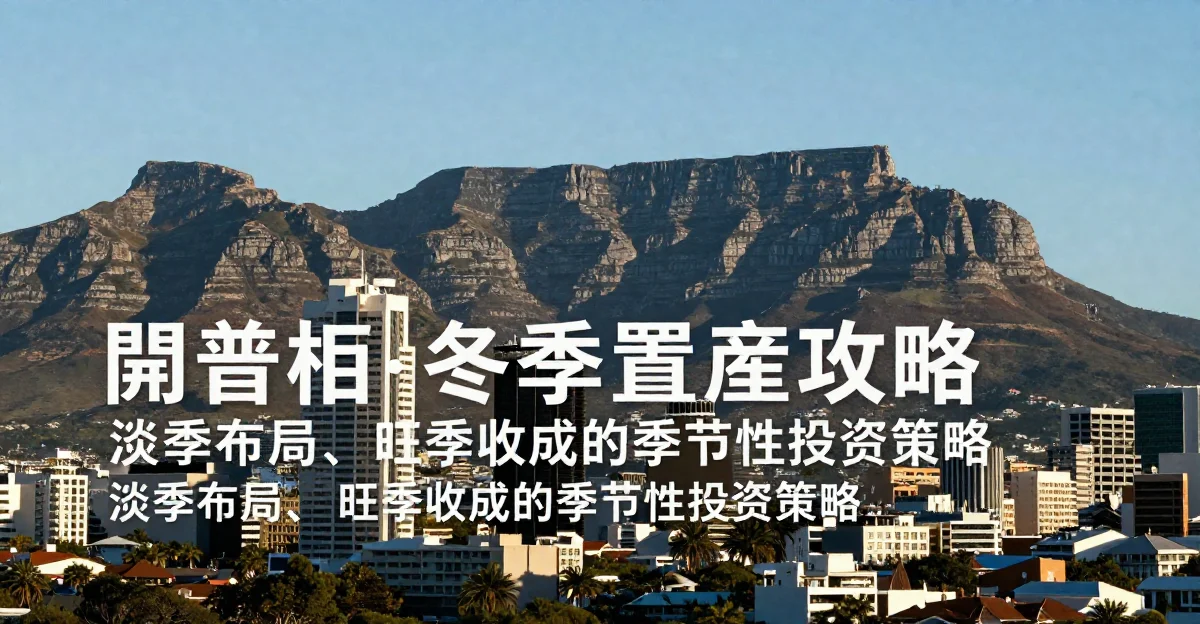
While the Northern Hemisphere enjoys summer, Cape Town is heading into winter — and that is precisely when savvy overseas property investors should be making their move. Cape Town's property market follows clear seasonal patterns: summer (December through February) drives peak rental demand from tourists, while winter (June through August) opens the widest negotiation windows. For investors who understand counter-cyclical strategy, winter isn't a waiting period — it's the optimal entry point.
Cape Town's Seasonal Market Rhythm
Cape Town's property market follows four seasonal phases. Winter (June–August) is the traditional low season — sellers motivated by semigration, relocations, or financial needs accept competitive offers, with premium areas like V&A Waterfront and Atlantic Seaboard offering 3–8% negotiation room. Spring (September–November) sees returning international buyers and shrinking deals. Summer (December–February) drives peak rental yields but tight seller leverage. Autumn (March–May) suits portfolio review and strategy adjustment.
Seeff's market reports confirm that winter-listed properties frequently reflect urgent seller circumstances, creating genuine buying opportunities. Property24 data verifies June–August transactions carry a 3–5% seasonal discount versus summer peaks.
The Hidden Advantages of Off-Season Negotiation
Winter entry delivers more than just price discounts. It delivers optionality.
1. Greater Negotiation Leverage
With supply high and demand low, winter sellers are more receptive to conditional offers. In Atlantic Seaboard and V&A Waterfront, off-season negotiation space ranges from 3% to 8%. On a R 10,450,000 property, potential savings of R 310,000 to R 835,000 immediately boost your yield-on-cost.
2. Tech Tenants Flattening Seasonal Demand
Amazon, Microsoft, and Google maintain significant Cape Town operations, bringing international remote workers year-round. Claremont and Sea Point — the city's primary tech corridors — show noticeably flatter seasonal vacancy than tourism-dependent areas. For winter buyers, this means income generation starts before the summer peak.
3. Winter Reveals Real Living Quality
Cape Town winter temperatures range from 7°C to 17°C — milder than most investors expect. A winter inspection reveals authentic commuting conditions, neighborhood dynamics, and residential infrastructure that summer holidays never show.
The Dual-Engine Structure for Counter-Seasonal Strategy
DingYao's Phase 1 South Africa plan deploys a dual-engine architecture purpose-built for the "buy in winter, earn through summer" approach.
Entry threshold: R 16,000,000
| Component | Amount | Purpose |
|---|---|---|
| Property purchase | R 10,450,000 | Premium Cape Town location |
| Transaction costs | ~R 550,000 | Transfer, legal, trust setup |
| Standard Bank Wealth call deposit | R 5,000,000 | 6.5% daily-compounding, monthly payout |
Dual-engine annual cash flow:
- Rental engine: R 10,450,000 × 8-10% = R 836,000 – R 1,045,000/year (full-occupancy rental income; income is earned only when units are occupied)
- Interest engine: R 5,000,000 × 6.5% daily compounding paid monthly ≈ R 335,000+/year (effective annual rate approximately 6.72%, including compounding effect)
- Combined annual cash flow: R 1,171,000 – R 1,380,000
The critical winter advantage: your R 5,000,000 call deposit begins earning interest from day one. Monthly interest of approximately R 86,000 (daily interest approximately R 2,849) accrues even during the property search period. Under the lawyer trust protection (律師信託保護) structure, not a single rand sits idle.
Lawyer Trust Protection: The Remote Execution Safety Net
For overseas investors, the primary concern with winter positioning is clear: remote transaction security.
DingYao's lawyer trust protection (律師信託保護) mechanism addresses this directly:
Fund Security
The entire R 16,000,000 is held in a trust account by a practicing South African attorney, regulated under South African law. No funds move without client authorization.
Document Assurance
All transaction documents undergo legal review — clear title, regulatory compliance, contractual protection.
Remote Execution
No travel required. The legal team handles due diligence, conveyancing, and lease management on your behalf.
Executing the Winter Advantage: A Four-Step Playbook
Cape Town's reversed seasons relative to the Northern Hemisphere create a unique "winter dividend" for overseas investors.
The Four-Step Winter Dividend
Winter Inspection and Selection (June–August)
Commission DingYao's professional team for on-site property inspections, or visit personally to experience authentic Cape Town winter living. Target semigration hotspots: V&A Waterfront, Atlantic Seaboard, Claremont. Maximum negotiation leverage. Optimal deal conditions.
Spring Transaction Completion (September–November)
Execute conveyancing through the lawyer trust protection (律師信託保護) structure. The R 5,000,000 Standard Bank Wealth call deposit activates its interest engine immediately upon receipt. Property handover launches the rental management process.
Summer Harvest (December–February)
Peak-season tourism drives short-term rental premiums. A blended strategy — short-term holiday lets supplemented by stable tech-industry long-term tenants — maximizes income. The annual cash flow target of R 1,171,000 – R 1,380,000 comes within reach.
Autumn Optimization (March–May)
Review lease performance. Adjust the tenant mix between short-term and long-term. Evaluate capital appreciation and consider whether to scale into a second Phase 1 position.
Comparison: Cape Town vs Other Overseas Investment Markets
| Metric | Cape Town | London | Dubai | Singapore |
|---|---|---|---|---|
| Entry threshold | R 16,000,000 | ≈R 50M+ | ≈R 15M | ≈R 40M+ |
| Annual rental yield | 8-10% (full occupancy) | 3-4% | 5-7% | 2-3% |
| Off-season negotiation room | 3-8% | <2% | 5-10% (off-plan) | <1% |
| Fund security (trust) | Lawyer trust protection (律師信託保護) | Basic protection | Developer escrow | Basic protection |
| Annual cash flow (dual-engine) | R 1.17M–1.38M | — | — | — |
Conclusion
Cape Town's winter is not a season to observe from the sidelines — it's the season to enter.
Off-season negotiation leverage, year-round tech-tenant demand, and the Southern Hemisphere's inverted seasonal calendar create a "winter dividend" unique to overseas property investors. Combined with DingYao's Phase 1 dual-engine structure — where the rental engine and interest engine work simultaneously from day one — an R 16,000,000 investment portfolio begins generating cash flow immediately, with every rand protected under lawyer trust protection (律師信託保護).
The Southern Hemisphere winter has arrived. So has the optimal entry window. Consult DingYao today to position yourself for Cape Town's counter-seasonal advantage.
Frequently Asked Questions
References & Data Sources
Leo Pan
CEO, DingYao Advisory
Specializing in South African property investment, education planning, retirement migration, and residency structuring. Over 10 years of cross-border advisory experience, leveraging technology to provide transparent, real-time portfolio oversight for investors in the Asia-Pacific region and beyond.