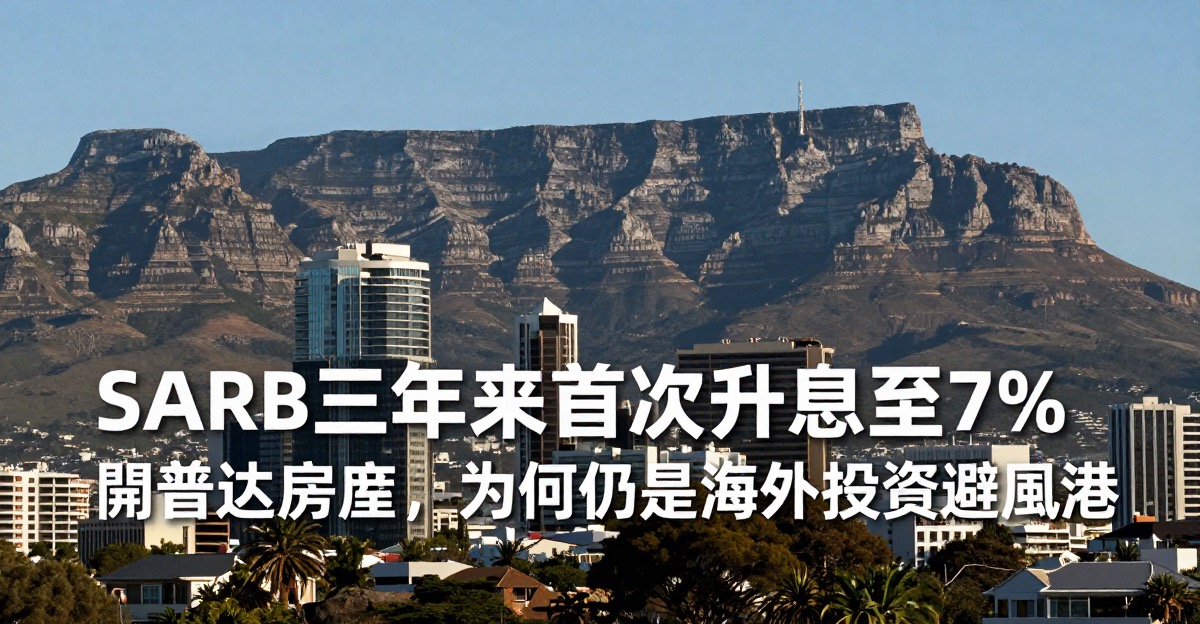
SARB Rate Hike and Cape Town Property Safe Haven
Overseas Investment June 15, 2026 9 min read

SARB's First Rate Hike in Three Years: Why Cape Town Property Remains a Safe Haven

SARB raised the repo rate to 7.00%, pushing prime rate to 10.50%. For overseas cash buyers, this redistributes competitive advantage. Dual-engine annual cash flow R 1,171,000-1,380,000.

SARB Rate Hike
Safe Haven
Dual-Engine Cash Flow
SH
Scott Huang

CEO, DingYao Advisory

The First Rate Hike in Three Years

On 28 May 2026, SARB raised the repo rate by 25 basis points to 7.00%, with the prime lending rate moving to 10.50% — the first increase since May 2023. Of 19 economists surveyed by Bloomberg, 17 expected the hike. The rand briefly strengthened before stabilising, and the bond yield curve shifted upward.

For investors holding South African assets, one question stands out: does a rate hike make Cape Town property less attractive? The answer is the opposite — for overseas cash buyers, a rate hike strengthens Cape Town's structural investment advantage.

Local Pressure vs Overseas Opportunity

The prime rate rising from 10.25% to 10.50% means every R 1,000,000 in mortgage debt costs roughly R 165 more per month. BetterBond reports that a 25-basis-point increase reduces maximum local loan capacity by approximately 2-3%, with high-end financed buyers particularly sensitive.

But Cape Town's premium market has a different demand structure — foreign buyers account for over 40% of transactions above R 10 million, and most are cash purchases. BetterBond data confirms foreign buyers' average purchase price is R 2.7 million versus R 1.6 million for local buyers, with only about 50% using financing. In the R 10,450,000 premium segment, cash buyers dominate. A rate hike is not a risk — it is a competitive advantage catalyst.

Cape Town Property's Rate-Resistant Structure

Cape Town's supply constraints are structural, not cyclical. Property24 data shows listings declining from 6,584 in December 2025 to 5,759 in May 2026 — a 12.6% inventory contraction. Fewer listings plus rate-pressured local demand equals stable prices with slower transaction velocity — the ideal window for overseas cash buyers.

Cape Town's rental demand engine is not driven by local tenants — it is powered by international corporate assignees, digital nomads, and lifestyle migrants. International arrivals grew 20% year-on-year in 2025. After SARB's rate hike, local mortgage holders lean toward renting rather than buying, giving Cape Town's rental markets dual support: growing international demand plus rising local rental demand.

Western Cape consistently records the shortest selling times nationally (Lightstone data), reflecting stronger governance quality. In a rising-rate environment, this governance differentiation becomes more pronounced — investors gravitate toward markets with better risk-adjusted returns.

DingYao Phase 1: A Dual-Engine Stabiliser

Component Amount Description
Property purchase R 10,450,000 Rental engine: 8-10% full occupancy = R 836,000 - 1,045,000/year
Associated costs ~R 550,000 Transfer, conveyancing, trust setup
Standard Bank Wealth call account R 5,000,000 Interest engine: 6.5% daily-compounded ≈ R 335,000+/year
Combined annual cash flow R 1,171,000 - 1,380,000 Dual-engine structure

Rental Engine: R 10,450,000 × 8-10% = R 836,000 - R 1,045,000/year (full occupancy income; income only when rented). Rate hikes boost rental demand as more people choose renting over buying. Cape Town international rental demand is growing 20%.

Interest Engine: R 5,000,000 × 6.5% daily-compounded monthly interest ≈ R 335,000+/year (effective annual rate ~6.72%). In a rising-rate environment, deposit rates typically follow the benchmark upward — Standard Bank Wealth call account rates have upside potential.

Combined dual-engine annual cash flow: R 1,171,000 - R 1,380,000, which may actually increase in a rising-rate environment — a structural advantage exclusive to overseas cash buyers.

Lawyer Trust Protection (律師信託保護)

All funds operate through a lawyer trust protection structure — from remittance through property transfer to the call account, client funds remain in an independent trust account and never enter any personal account. Rate-driven market volatility does not affect the security of trust-held funds.

The full R 16,000,000 begins earning interest immediately, at approximately R 86,000 per month (R 2,849 per day). After the rate hike, this waiting-period interest may be even higher.

Rand Appreciation: The 6.45% Annual Gain

Despite SARB's rate hike, the rand has appreciated 6.45% against the US dollar over the past 12 months, currently trading around USD/ZAR 16.5. RMB's REER analysis indicates the rand remains 6-10% undervalued — suggesting further upside. For overseas investors, the current rand level still contains a currency discount, and SARB's rate hike further supports the rand — a double benefit.

Conclusion: Rate Hikes Are Local Risk, Overseas Opportunity

SARB's first rate hike in three years is a stress test for South African mortgage holders, but for overseas cash investors, it is a competitive redistribution opportunity. Cape Town property's scarce supply, international rental demand, governance premium, and dual-engine cash flow structure not only withstand rising rates — they become more attractive.

For Asian investors considering overseas property, the signal is clear: when local buyers step back due to interest rates, cash buyers secure the best terms. DingYao's Phase 1 configuration at R 16,000,000 gives you rental income plus interest income plus rand appreciation potential — a triple-return structure that strengthens in a rising-rate cycle.

Frequently Asked Questions

How does the SARB rate hike affect Cape Town property prices?
Rate hikes compress affordability for local financed buyers, but overseas cash buyers represent over 40% of premium transactions, and supply continues to contract (listings down 12.6%). Western Cape price growth forecasts remain at 4-7% for 2026.
Why do overseas cash buyers gain an advantage in a rising-rate environment?
Cash buyers are unaffected by local mortgage rates. When financed buyers retreat, cash buyers' negotiating leverage expands, while rental demand rises as more people choose to rent rather than buy.
Will Standard Bank Wealth call account rates increase after SARB's hike?
Bank deposit rates generally follow the benchmark. After SARB's rate hike, the 6.5% annual rate on the Standard Bank Wealth call account has upward potential, meaning R 5,000,000 in interest income may increase.
How does the R 16,000,000 dual-engine cash flow change after a rate hike?
Combined annual cash flow of R 1,171,000-R 1,380,000 may increase: the rental engine benefits from rising rental demand, and the interest engine benefits from higher deposit rates. This structural advantage is exclusive to overseas cash buyers.
How does lawyer trust protection (律師信託保護) ensure fund safety?
All funds operate through a lawyer trust protection structure. From remittance through property transfer to the call account, client funds remain in an independent trust account and never enter any personal account. Rate-driven market volatility does not affect the security of trust-held funds.
SH

Scott Huang

Business Development

Specialising in South African property investment, education planning, retirement living, and residency solutions. Over 10 years of cross-border advisory experience, committed to technology-driven transparency so Taiwanese investors can manage wealth and future as if they were on the ground.

Rate Hike = Opportunity Window for Cash Buyers

SARB's First Rate Hike in Three Years — Your Entry Window

R 16,000,000 dual-engine annual cash flow R 1,171,000-1,380,000, with lawyer trust protection (律師信託保護) — your overseas investment is secured from day one.

8-10%

Full-Occupancy Rental Yield

6.72%

Effective Annual Rate (Daily Compounding)

R 1.38M

Annual Cash Flow Ceiling

Consultation is completely free with no hidden fees. Your information will be kept strictly confidential.

Related Reading: More South Africa Investment Insights