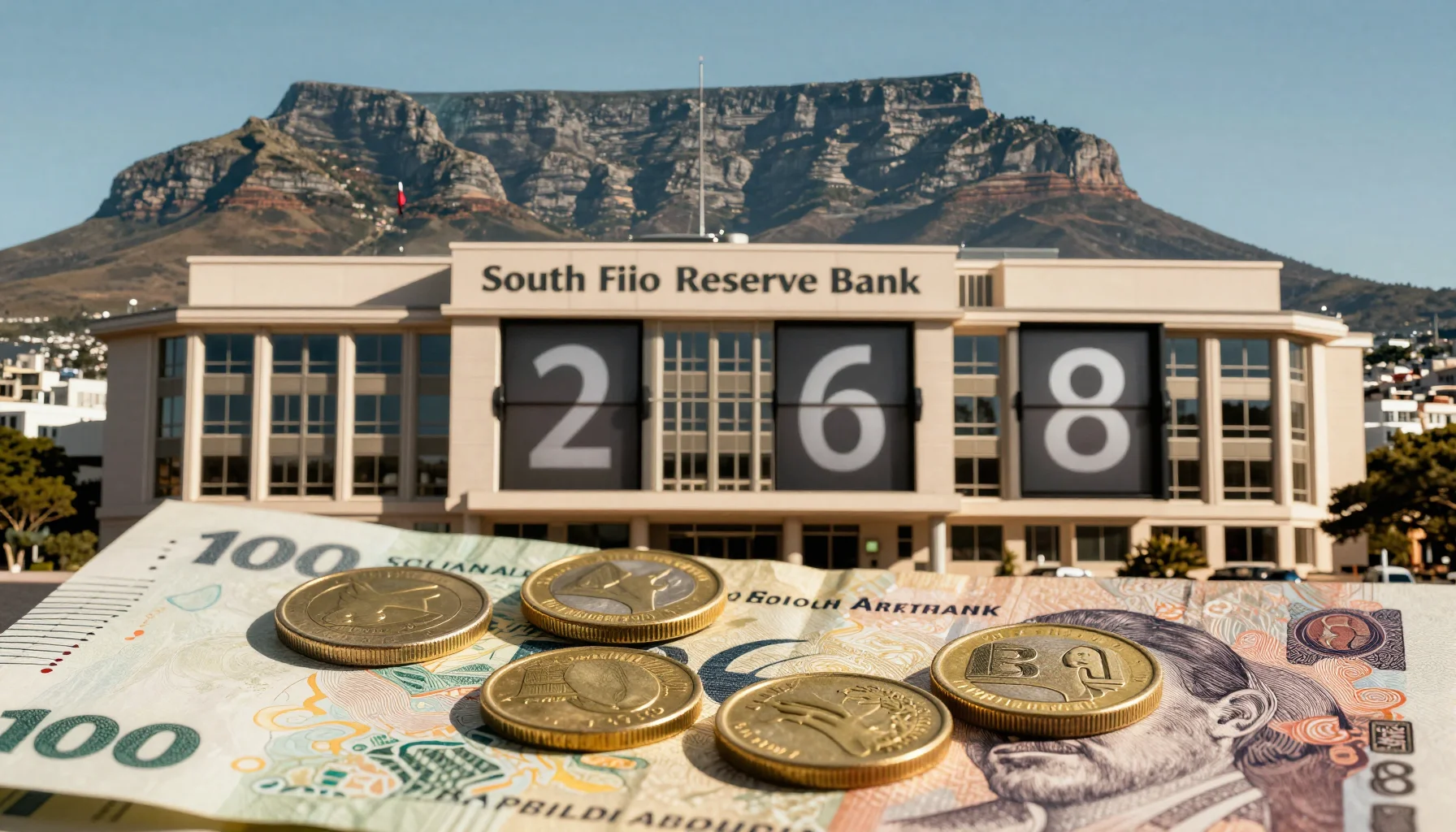
South African Reserve Bank headquarters and the Cape Town skyline, presenting a macro visual of the September 23 rate decision preview, the rand currency and the property market

SARB September 23 MPC Preview: Rand Strength, Cooling Inflation, and the Pre-Cut Cape Town Property Window

"The SARB's next MPC meeting is almost here!" This is the most time-sensitive macro event in South Africa this week. The South African Reserve Bank's (SARB) next rate decision is set for September 23 (confirmed by resbank.co.za and Nedbank's "next MPC 23 September 2026"), and the QPM (Quarterly Projection Model) has signalled "policy rates broadly stable for the rest of the year, with the model showing a cut later in the year." At the same time, the rand has firmed to 16.01 against the dollar (August 25, resbank.co.za Selected Historical Rates), while South African inflation is cooling after peaking at 5% in June.

For Taiwan investors, this is not an internal South African meeting you can ignore — it is the countdown to the question "is now the last low to enter Cape Town property?" If the SARB cuts on September 23, mortgage costs fall and property demand is released, and Cape Town could see a wave of buying push prices higher. Rather than chase a post-cut market, understand the logic of "pre-cut positioning" — locking in currency, rates and bargaining room before the rate inflection arrives.

Key Summary: Worth positioning. The SARB's next MPC meeting is September 23 with market rate-cut expectations rising, and the QPM signals "a cut later in the year." The rand trades at 16.01 (August 25), and South African inflation cools after peaking at 5% in June. Together, the three factors (rate outlook, rand, inflation) form a pre-cut Cape Town property window — if rates fall, mortgage costs drop and demand is released, so positioning early locks in cost and bargaining room. Consult DingYao today for three-factor reading and a Cape Town property strategy.


September 23 Rate-Cut Preview: From "Hold" to "A Cut Later in the Year"

Let's give a clear forward view first: the SARB could cut on September 23, and market expectations are heating up. Why? The answer lies in the SARB's own decision trajectory. At its July 23 meeting, the SARB unexpectedly held at 7% against market expectations of a hike, citing that "policy was already restrictive" (Reuters 7/23, Moneyweb 7/23), with four members supporting the hold — that "surprise hold" already hinted the committee was beginning to lean toward loosening.

More telling is the SARB's QPM signal. The QPM shows "policy rates broadly stable for the rest of the year, with the model showing a cut later in the year" (resbank.co.za), and with Nedbank explicitly flagging "next MPC 23 September 2026," market expectations of a September 23 cut keep rising. For Taiwan investors, this means the next few months may be a "time-gap window" where Cape Town mortgage costs are still relatively high but prices have not yet priced in a rate cut — precisely the core logic of "pre-cut positioning."

Next MPC 9/23

Confirmed by resbank.co.za and Nedbank; the next South African rate decision is set for 2026/9/23.

QPM "Cut Later"

SARB's projection model shows policy rates broadly stable this year with a cut later, and expectations are rising.

7/23 Hold

The SARB unexpectedly held at 7% against hike expectations, with four members supporting, hinting at a loosening bias.

Mortgage Inflection

If the September 23 meeting cuts, floating mortgage rates follow and Cape Town property financing costs drop sharply.

Key Insight: From the surprise hold on July 23 to a QPM signalling "a cut later in the year" and the September 23 meeting ahead, the SARB is standing on the threshold of a rate cut. For Taiwan investors this is a "time-gap window" — mortgage costs have not fully priced in a cut, and prices have not reacted early — making now a position to buy Cape Town before the cut.

"The SARB's QPM has already signalled 'a cut later in the year,' and September 23 is that key node. Read the policy inflection, and you'll see the position where Cape Town buyers should act before the cut lands and prices react." — Scott Huang, CEO, DingYao Advisory

The Three-Scenario Playbook: Cut, Hold, or Hike of September 23

Having understood the rate-cut preview, the next key is to model the three possible September 23 outcomes and their impact on Cape Town property. Professional investors do not bet on a single result — they build a three-scenario framework and prepare a response for each.

Scenario Probability Impact on Cape Town Property Taiwan Investor Strategy
Rate cut (e.g. 25bps) ~55% (expectations rising) Mortgage costs fall, demand released, Cape Town prices push higher Buyer's market — bargaining room remains, lock in targets early
Hold at 7% ~35% Financing stays stable, buyer bargaining room extends Choose areas deliberately, lengthen the evaluation window
Unexpected hike ~10% (low probability) Mortgage costs rise, short-term buyer sentiment cools, but scarce Cape Town supply supports prices Cash / low-leverage investors gain an edge

Key Insight: The three-scenario playbook is: a cut (~55%, mortgage costs drop and demand releases — a strong tailwind), a hold (~35%, financing stable and bargaining extends), and a hike (~10%, short-term cooling but scarce Cape Town supply supports prices). Whatever the outcome, Cape Town stays relatively resilient on interest sensitivity and scarce supply — and pre-cut positioning is how you get ahead in the most likely cut scenario.

"Investors' biggest risk is not choosing wrong, but failing to set scenarios. Hike, hold, or cut — Cape Town is more resilient on every path than most markets, because its moves depend not only on rates but on scarce supply and foreign demand." — Scott Huang, CEO, DingYao Advisory

The Rand at 16.01: Why Pre-Cut Positioning Locks In a Currency Edge

The third key factor is currency. According to resbank.co.za Selected Historical Rates, the rand traded at 16.01 against the dollar on August 25 (USD/ZAR 16.0115), sitting at a relatively strong level. This firm rand is both a tailwind and a consideration for Taiwan investors — a firm rand means South African assets are worth more in Taiwan-dollar terms, but entry costs are also relatively higher.

This is another layer of the "pre-cut positioning" advantage: entering while rates are still high, before a cut has landed, typically means the currency has not yet swung sharply on a cut. If the SARB cuts on September 23 and capital flows in, the rand could strengthen further — entering then would mean "chasing a more expensive currency plus a higher price." Conversely, pre-cut positioning lets you lock in a relatively stable currency level and enjoy the asset-appreciation dividend of a stronger rand afterward.

Rand at 16.01

Official rate on August 25 from resbank.co.za; the rand is relatively firm, lifting South African assets in TWD terms.

Pre-Cut FX Window

Before a cut, the currency has not yet swung sharply, so entering locks in a relatively stable level and avoids chasing later.

Inflation Cooling at 5%

South African inflation peaked at 5% in June and is cooling, lifting real-asset value-preservation demand and a sound property foundation.

Long-Term Appreciation

A firmer rand plus rate-cut demand release gives Cape Town assets long-term appreciation momentum.

Key Insight: The rand at 16.01 (August 25) is relatively firm, and South African inflation peaked at 5% in June and is cooling. The core value of pre-cut positioning: the currency has not yet swung on a cut (locking in cost), and prices have not yet priced in a cut (avoiding a chase). Position with the dual-engine model before the rate inflection, then enjoy the appreciation dividend of a stronger rand and released demand.

Taiwan Investors: A Four-Step Pre-Cut Playbook With the Dual-Engine Model

Having understood the rate-cut preview, three scenarios and currency, how does a Taiwan investor turn "pre-cut positioning" into action? The four steps below walk you through "read → allocate → comply → hold", paired with DingYao's dual-engine cash-flow model to secure returns.

Dual-Engine Cash-Flow Model: Cape Town property is not a one-way bet on price movement — it is a "rents + rates" dual engine. Take a R 16,000,000 total allocation: property purchase R 10,450,000, trust deposit R 5,000,000. Rental engine: 8-10% annual yield (R 836,000-R 1,045,000/yr); interest engine: around R 335,000/yr. The combined annual yield reaches 7.3-8.6%, with a natural hedge — when rates rise the interest engine strengthens, and when rates fall the rental engine benefits. Pre-cut positioning is what lets the dual engine strengthen on both sides after September 23.

01

Read the September 23 Outlook

Review the SARB QPM "cut later" signal, the September 23 timeline, the rand at 16.01 and inflation cooling at 5%. Set your pre-cut budget and goals against the three-scenario framework, and decide whether to act before the rate inflection.

02

Select an Area and Target by Goals

Choose an area by capital and return goals: chase appreciation in the Atlantic Seaboard premium zone (City Bowl net rental yield 7.5-7.9%), or chase cash flow in 8-10% rental hotspots. Use the local team to pick targets with better bargaining room before the cut.

03

Compliance and Purchase

Use DingYao's local team to complete the SARB balance-of-payments declaration (BOP code), inbound capital compliance and conveyancing, protect the deal with lawyer trust arrangements, and lock in the current divergent currency level before the cut.

04

Property Management and Dual-Engine Holding

Engage property management for the 8-10% rental yield, and pair it with the post-purchase interest engine (R 335,000/yr), so the combined 7.3-8.6% yield strengthens on both sides after a September 23 cut and turns Cape Town assets into stable long-term returns.

Key Insight: A Taiwan investor's pre-cut playbook has four steps: read the September 23 outlook → select an area by goals → comply and purchase → manage and hold with the dual engine. Through the R 16,000,000 dual-engine model (8-10% rents + interest engine), you turn the SARB September 23 rate-cut outlook into a concrete Cape Town property action.

Conclusion: Master the Pre-Cut Window and Position at Cape Town's Rate Inflection

The SARB's next MPC meeting is September 23, the QPM signals "a cut later in the year," the rand trades at 16.01, and South African inflation cooled after peaking at 5% in June — these are not four isolated financial headlines, but the "rate outlook + rand + inflation" three-factor signal for a pre-cut Cape Town property window.

For Taiwan investors, if the SARB cuts on September 23, mortgage costs fall and property demand is released, and Cape Town could see a wave of buying push prices higher. Rather than chase a post-cut market, position before the rate inflection to lock in currency, rates and bargaining room — reading the three factors, using the dual-engine model, and choosing the right area and timing are the key to positioning at Cape Town's rate inflection.

Want to use the SARB September 23 outlook, the rand, and inflation to time your Cape Town property entry? Book a consultation now and let DingYao Advisory help you read the three factors, capture the H2 2026 window, and plan a one-stop property strategy with the dual-engine model.

FAQ

Is the SARB's next MPC meeting really set for September 23?

Yes. The South African Reserve Bank's next MPC meeting is confirmed for September 23, 2026 by resbank.co.za and Nedbank ("next MPC 23 September 2026"). This follows the surprise hold at 7% on July 23, and market expectations of a rate cut are rising.

If the SARB cuts rates on September 23, how much will Cape Town mortgage costs fall?

A SARB cut lowers floating mortgage rates (currently around prime at 10.75%). On a R 10,450,000 Cape Town property with a 50% loan, each 25-basis-point cut would reduce monthly payments by several thousand rand, reinforcing the 8-10% rental yield for long-term holders and strengthening dual-engine cash flow.

The rand at 16.01 against the dollar — is that a tailwind or a rising entry cost for Cape Town property?

It depends on the reference currency and timing. A rand at 16.01 (August 25) means South African assets are worth more in Taiwan-dollar terms — a tailwind for holders, but a slightly higher entry cost for new buyers. If a September 23 cut releases demand, price momentum may outweigh currency cost, so a pre-cut entry can lock in both currency and rate.

Is it better to invest before the rate cut or wait until after?

There is no universal answer, but a pre-cut entry offers two advantages: locking in current bargaining room (price growth is still slowing) and avoiding a post-cut demand surge that pushes prices higher and misses the low. Consult DingYao's local team to select a target before the cut and allow for the cash-flow gain from lower rates afterward.

How should Taiwan investors use the three factors to time Cape Town property before the SARB's September 23 meeting?

The three factors are rates, currency and house-price momentum: rates point to a cut outlook (September 23 lowers mortgage cost), the rand at 16.01 lifts South African asset value, and moderating price growth offers bargaining room. Pair this with DingYao's dual-engine model (8-10% rents plus an interest engine for a combined 7.3-8.6% yield) to finalize readout and area selection before September 23.

Related Reading

Read the SARB September 23 Outlook, Rand Strength, Cooling Inflation — Position at Cape Town's Rate Inflection

The SARB's next MPC is September 23 with expectations rising, the rand at 16.01, and inflation cooling. These three factors form a pre-cut Cape Town property window. Book a consultation now and let DingYao Advisory read the three factors and plan a one-stop property and residency strategy with the dual-engine model.

Book a Property Assessment Now