How Are Cape Town Property Rates Calculated? The GV2025 Roll, the R620,000 Rebate and a Foreign Buyer's Rates Bill

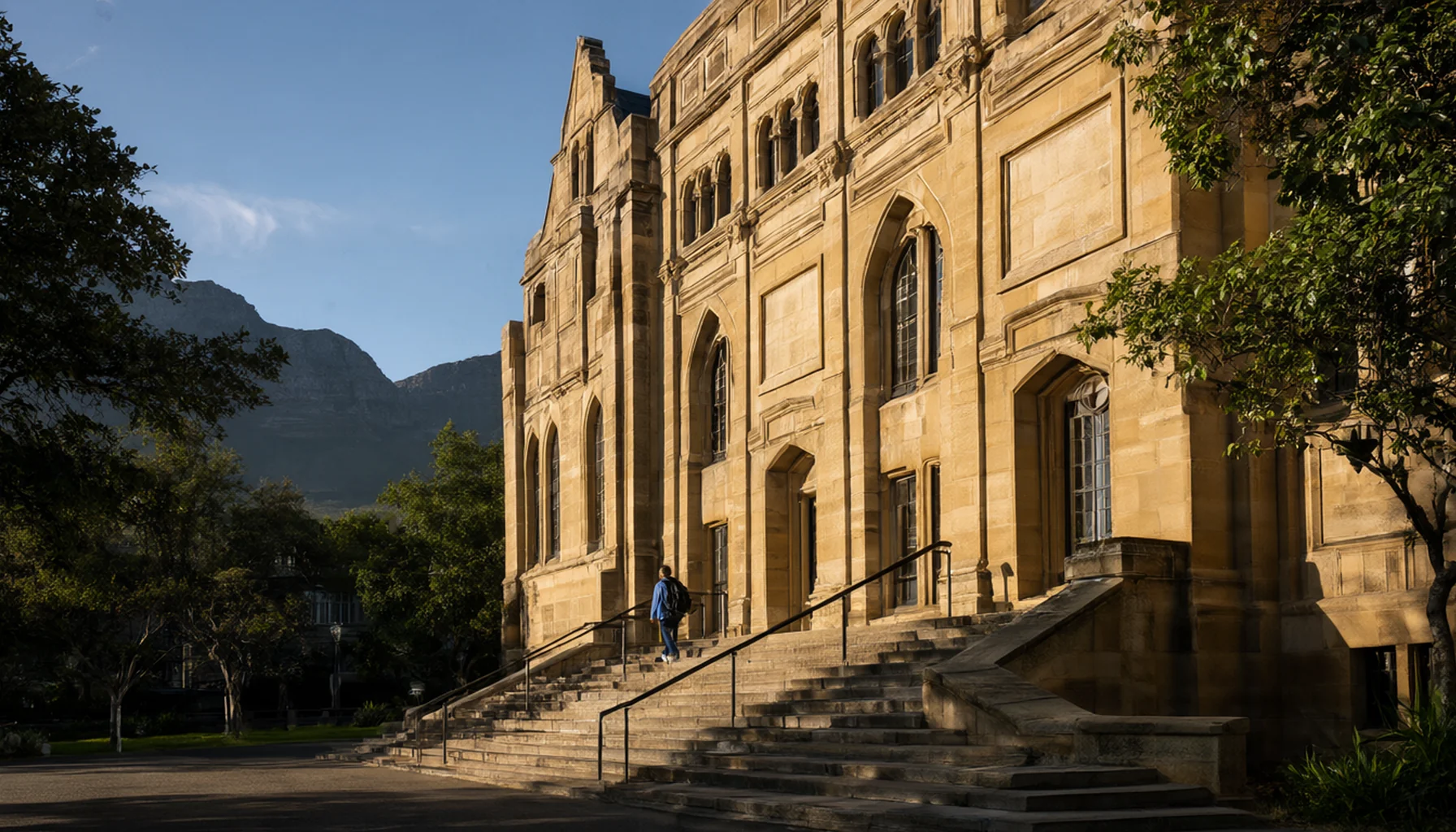
University of Cape Town campus and international student application documents

Studying at UCT: International Student Fees, Entry Requirements and Taiwan Recognition

Over the past two years the question from Taiwanese families in Cape Town has shifted from which primary or secondary school to what happens at university. The shift is measurable: the private-schools article published on this site on 29 October drew 6 clicks, 71 impressions, an 8.5% CTR and an average position of 8.1 within 28 days, which means a group of Taiwanese parents is evaluating South African education seriously and their next question is cost and recognition back home.

Four orientation points before the detail. University of Cape Town international students apply through the same undergraduate portal as local candidates. UCT tuition fees for international students are four layers, not one number. UCT admission requirements for international students turn on NSC equivalence and faculty-specific scores. And anyone planning to study in South Africa should start from the closing date, because it does not move. The detail below is drawn from the 2026 fee handbook and the 2027 application cycle.

The University of Cape Town (UCT) is the name that comes up first. This article turns the 2026 official numbers into a usable table: application opening and closing dates, the international fee structure, actual residence prices, and how Taiwanese qualification recognition works. Fees and entry requirements change every year; every figure below carries its source and retrieval date. This is information, not admission or investment advice.

Key takeaway: UCT undergraduate applications for the 2027 academic year open on 1 April 2026 and close on 31 July 2026; late applications are not considered. International students pay tuition plus an International Term Fee and an International Administrative Fee, with the first payment due by 6 February 2026 (a 5% surcharge applies to late payment). A 2026 first-tier catered single room is R89,520; adding the R25,520 meal option brings it to about R115,040 a year. Recognition in Taiwan requires checking the Ministry of Education reference list; this article does not determine whether UCT appears on it. All figures below are Cape Town campus rates.


UCT campus and choosing a South African university

What are the options for studying in South Africa?

UCT is a public research university in Rondebosch, Cape Town, teaching in English across 6 faculties in 2026, and it is the first name Taiwanese families ask about. Together with Stellenbosch University and the University of the Witwatersrand (Wits) it forms the trio most often compared, and the real differences are location, language environment and daily life rather than a single ranking.

For a Taiwanese family the practical difference is this: UCT sits in the city where most of our clients already have a base - the southern suburbs, Rondebosch and Newlands - so a child can move into university without changing city or rebuilding a support network. Stellenbosch is roughly 50 km east in the winelands, with a different cost base and pace; Wits is in Johannesburg, a different demographic and industry environment altogether; for a family already based in Cape Town, that geography is usually the deciding factor.

If the plan is school in Cape Town and university in Cape Town, the real question is not which institution but how much time is left before the closing date to assemble documents and results. The timeline below is built for that question.

Key date (2027 entry)DateWhat it means for a Taiwanese applicant
Undergraduate applications open2026-04-01Submit early; scholarships and residence places are reviewed on a rolling basis
Undergraduate applications close2026-07-31No late applications, no extension window
Postgraduate coursework close2026-09-30Research degrees accept applications through the cycle
First fee payment due2026-02-06 or before registrationWhichever is earlier; one-off 5% surcharge if late
Balance of fees due2026-07-31Same day as the application deadline, easy to collide

(Source: UCT, Application procedure, 2027 cycle, retrieved 31 October 2026; payment dates from UCT Student Fees 2026, section 1; UCT, Cape Town)

UCT international admission documents and grade equivalence

What are the entry requirements for international students?

UCT requires international applicants to hold a school-leaving qualification equivalent to the South African NSC, and for 2027 entry the undergraduate deadline is 31 July 2026. Admission is decided faculty by faculty: the required score differs by programme, and medicine, engineering and commerce sit well above humanities and social sciences.

The three questions Taiwanese students ask most are answered in official documents, not in rumour. First, equivalence: a Taiwanese high school certificate must be assessed as equivalent, and that determination is made case by case by UCT admissions. Second, English: where secondary schooling was not in English, a test score is normally required, and which tests and cut-offs are accepted is set by the current admissions page. Third, application fee: R100 for South African and SADC applicants and R300 for other international applicants, as reported in third-party summaries of the 2027 cycle - confirm the amount in the UCT portal before paying.

One step Taiwanese families routinely miss: the National Benchmark Test (NBT). Some faculties require it, and it must be completed before the closing date. For an overseas applicant the scheduling and time difference are where applications actually fail, which is why exam booking belongs on the first line of the timeline, not the last - Cape Town test centres fill early in the cycle.

(Source: UCT Application procedure, 2027 cycle, document requirements, retrieved 31 October 2026; UCT, Cape Town)

On documents, international applicants need school transcripts and proof of completion in English (certified where required), a passport copy, an English test result, portfolios or motivation letters for some programmes, and proof of funds for the student visa stage. Validity periods follow the admissions page for that cycle, and expired documents are not extended automatically; the clock on a Cape Town application runs from submission, not registration.

UCT tuition and international fee structure

How much does UCT cost for an international student?

UCT international fees for 2026 are 4 layers added together: course tuition, an International Term Fee, an International Administrative Fee and residence fees. The Student Fees 2026 handbook states that non-SADC international students must pay all four, which explains why online figures for a year at UCT differ so widely - most count only the first layer; a Cape Town enrolment invoice shows all four.

Fee layer2026 official dataNote
(1) Course tuitionPriced per course and per faculty2026 humanities courses list around R9,880 to R13,170 each on the local fee table; international students are priced per course separately
(2) International Term FeeCompulsory for non-SADC international studentsAmount varies by category and qualification level; see section 5 of the current handbook
(3) International Administrative FeeCompulsory for non-SADC international studentsStated as non-refundable in all circumstances
(4) Residence and mealsSingle room from R89,520 (see below)Catered residences require a meal option on top
SADC administrative fee (comparison)R5,600Applies to SADC categories, not to Taiwanese students
Local first payment (comparison)R34,500South African citizens and permanent residents only

If you want one published total as a reference point, the Business School is the only unit that states it outright: the 2026 full-time MBA is R452,000 for international students against a R81,000 first payment for South African students. Same degree, same Cape Town university - that is the concrete size of the international premium. For undergraduate programmes there is no single average; the total must be built from the per-course fee for that faculty, the number of courses, the International Term Fee and the International Administrative Fee.

Payment timing matters as much as the amount: the first payment must reach UCT before registration or by 6 February 2026, whichever is earlier, with the balance due 31 July 2026 and a one-off 5% surcharge on late amounts. International transfers need about 14 working days to clear, or registration clearance stalls. (Source: UCT Student Fees 2026, sections 1 and 5.4, retrieved 31 October 2026; Cape Town campus)

UCT student residence and living costs in Cape Town

What do residence and living costs add?

A 2026 first-tier catered single room at UCT costs R89,520, and adding the R25,520 three-meal option brings the year to about R115,040. Residence fees sit outside tuition, and the spread between room types and tiers is where most families underestimate the annual total.

2026 residence optionAnnual fee (R)Note
First tier, catered, single room89,520Meals extra; shared double room R78,690 per student
Meal option 3 (breakfast and dinner)25,520Three meals a day is R37,940
First tier, health sciences designated, single98,850En-suite R108,910
Second tier, self-catering, single in flat68,080 to 73,080Groote Schuur Flats, Forest Hill and similar
Third tier, self-catering, single83,200 to 94,950Depends on en-suite and residence

Stack the layers and the cash requirement for one year at university in Cape Town becomes visible: course tuition for the faculty, plus the International Term Fee and Administrative Fee, plus R89,520 for a catered single room and R25,520 for meals. Living costs - transport, phone, books, flights home - are separate and broken down line by line in our Cape Town cost-of-living article rather than repeated here.

(Source: UCT Student Fees 2026, section 13 residence fee schedule, retrieved 31 October 2026; UCT, Cape Town)

One practical warning: residence offers expire. If the sign-in step is not completed by the stated time the offer is cancelled, and for an international student still waiting on a visa that gap has to be planned into the schedule - otherwise the tuition is paid and the room is gone - in Cape Town, residence offers often land before visa decisions do.

Post-study visas and work routes after a South African degree

Can you stay and work in South Africa after graduating?

Graduates can stay through a post-study visa and an employer-sponsored work visa, but permanent residence depends on employment and points and is never automatic. The degree supplies eligibility to apply, not a guarantee of residence.

The system has three layers: a short post-study arrangement that gives graduates time to look for work; an employer-sponsored critical-skills or general work visa requiring a real position and a salary threshold; and only then a permanent residence route built on points, years of experience and language. Cape Town's employment base is concentrated in financial services, tourism, technology, agricultural processing and healthcare, and international graduates meet a practical local-first preference for the same vacancy.

We would not frame a South African degree as an immigration plan. The sequence is degree and job first, residence second; reversing it produces the wrong financial decision. If residence is the family goal, start from the residence pathways article, work out which conditions you can actually meet, and only then decide whether the education plan should be shaped around it.

Recognition of South African degrees in Taiwan

Is a South African degree recognised in Taiwan?

Using a South African degree in Taiwan requires 3 steps: confirming the university is on the Ministry of Education reference list, authenticating documents, then applying for verification. There is no "probably fine" here: the list is the official basis and the procedure is a documentary exercise.

The process normally has three steps. First, check the list for the institution and the qualification level. Second, verify documents: the degree certificate and transcripts must be sent directly by the university or be notarised and authenticated through the relevant overseas mission. Third, apply for verification with whichever body the purpose requires - further study, a professional examination or employment. If an institution is not on the list, that does not automatically mean the degree is rejected; it means case-by-case assessment, which takes longer and carries no guaranteed outcome; for a Cape Town qualification the list is the only authority.

We do not decide this for you: whether UCT is on the current list, and whether your qualification needs individual assessment, must be confirmed against the Ministry of Education's current publication. Any claim that it is "definitely recognised" or "definitely not" should be treated as unreliable; the list is the only source, and Cape Town families should check it before the July deadline.

For families planning to return to Taiwan, the practical advice is to check the list before applying, not after graduating. If the target qualification is not covered, the alternatives - a different institution, or a career in South Africa - have to be chosen at the point of selecting a university, otherwise four years buy a degree that still needs case-by-case assessment. The same logic applies to further study: confirm the target institution's requirements for overseas qualifications first.

FAQ

How much does UCT cost per year for an international student?

There is no single number, because the cost is four layers: course tuition priced per faculty, the International Term Fee, the International Administrative Fee and residence. For 2026 a first-tier catered single room is R89,520 plus a R25,520 meal option; the Business School MBA at R452,000 is the one published international total, quoted as a Cape Town campus rate.

When do applications for 2027 close?

Undergraduate applications open on 1 April 2026 and close on 31 July 2026; late applications are not considered. Postgraduate coursework programmes close on 30 September 2026. The first fee payment is due before registration or by 6 February 2026, whichever is earlier, on the Cape Town campus calendar.

Can a Taiwanese high school qualification be used to apply?

It must be assessed as equivalent to the South African NSC, decided case by case by UCT admissions, and some faculties also require the National Benchmark Test or an English test. Accepted tests and cut-offs are set by the current admissions page.

Is a South African degree recognised in Taiwan?

Check the Ministry of Education reference list and complete document authentication and qualification verification. Not being listed does not automatically mean rejection; it means case-by-case assessment. This article does not decide the question, so check before choosing a Cape Town university.

Can graduates stay in South Africa to work or apply for residence?

They can apply, but nothing is automatic. Post-study arrangements, employer-sponsored work visas and permanent residence are three separate systems with employment and points conditions; a degree should not be planned as an immigration route; Cape Town employers still hire local first at equal merit.

Related Reading

University is the end of the education path; the earlier decisions determine whether you get there. These Cape Town education pieces continue the sequence.

Why handle this through Crestline Advisory?

South African university applications rarely fail on grades. They fail on timing and document format - the same transcript, sent the wrong way, is simply not accepted.

The three most common failure points

  • Transcripts not sent by the school: most international applications require direct dispatch or authentication, and a parent-uploaded scan triggers a resubmission request that costs three to six weeks.
  • NBT and English tests booked too late: test slots and time differences push candidates past the 31 July deadline, where no remedy exists.
  • Residence offer out of step with the visa: offers expire, and a cancelled room with tuition already paid is the usual outcome.

Working through our partner Crestline Advisory (on-the-ground execution in South Africa) means these are checked before submission: document format and dispatch method pre-screened item by item, exams and deadlines scheduled backwards from the closing date, residence offers aligned with visa timing, and local registration and guardianship support arranged.

DingYao confirms the consistency of your grades, documents and financial records on the Taiwan side and hands over to Crestline Advisory for execution. You do not receive a checklist and left to figure it out alone.

Get the timeline right before choosing a university

Closing dates do not move for anyone. Tell us your child's grade, target qualification, current results and English test status, and we will work back a 24-month schedule, list the documents and exams that must come first, and explain what to check for Taiwan recognition; for local execution we hand over to Crestline Advisory.

See South Africa education services

【Compliance & Disclaimer】

1. Company statement: DingYao Advisory is a Taiwan-based advisory firm covering asset allocation, immigration consultation, offshore account opening and second-generation education coordination. We hold no real estate agency licence in Taiwan, do not act as an agent in any property transaction, and do not operate as a study-abroad recruitment agent; admission decisions rest solely with the South African universities under their own regulations.

2. Sources and contracting party: Application opening and closing dates are from UCT's Application procedure page for the 2027 cycle; the fee structure, first and final payment dates and residence and meal rates are from the UCT Student Fees 2026 handbook, sections 1, 5.4 and 13 (retrieved 31 October 2026); the Business School international total is from the GSB payment table in section 1. The recognition procedure is described at the level of the current Taiwan Ministry of Education framework, and whether an institution is listed must be confirmed against the current publication. This article is information only and is not a guarantee of admission, investment or legal advice.

3. Statutory risk warning: Offshore property investment carries risk; read the marketing documents and consider carefully before trading. Fees quoted are 2026 published rates; tuition, residence fees and exchange rates change annually and the actual amount is whatever the university bills that year. Nothing here guarantees an admission outcome or a recognition outcome.