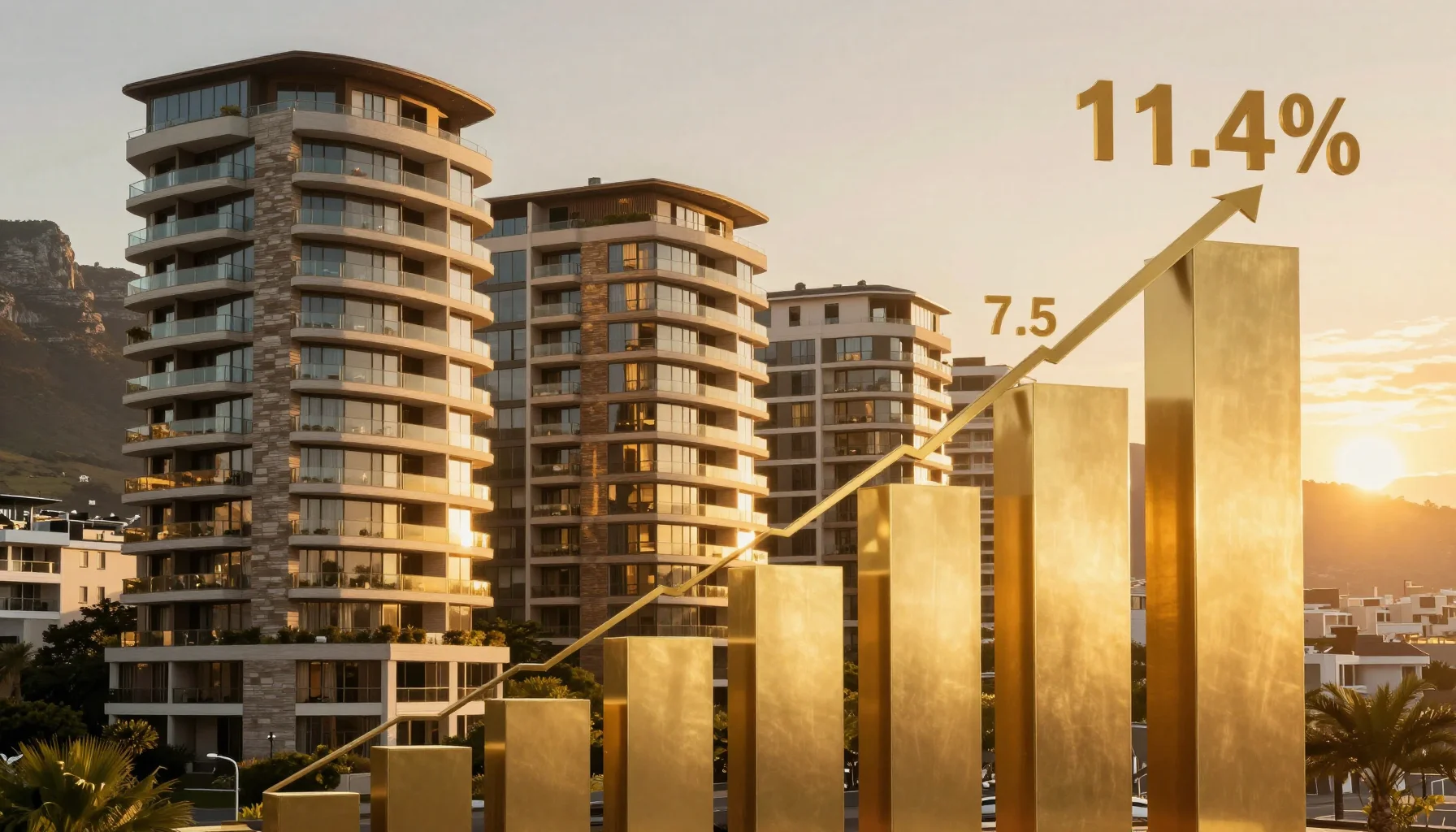
South Africa inflation decline curve and Cape Town seaside homes imagery, showing the shift from rate cuts to property positioning and investment strategy

South Africa Inflation Falls to 4.3%, SARB May Cut Rates on 9/19: The Pre-Rate-Cut Window for Cape Town Property

"South Africa's inflation has fallen to 4.3% — does that mean a rate cut is coming? Is this the moment to invest in Cape Town property?" This is the question on the minds of many Taiwanese overseas property investors and retirees right now. According to data released by StatsSA on 8/19, July consumer price index (CPI) fell to 4.3%, the first decline in 5 months, with food inflation falling to 0.9%, a 16-year low.

This data matters because cooling inflation directly shapes the monetary policy direction of the South African Reserve Bank (SARB). The market widely expects SARB's Monetary Policy Committee (MPC) to possibly start a rate-cutting cycle at its 9/19 meeting. If rates are cut, South Africa's prime lending rate will move down from 10.5%, lowering the borrowing cost of Cape Town property and widening the relative yield advantage of rentals — and this is precisely the golden pre-rate-cut window for positioning in Cape Town property.

Direct Answer: South Africa's July inflation fell to 4.3% (first decline in 5 months), with food inflation at 0.9% — a 16-year low. SARB is widely expected to cut rates on 9/19, and prime at 10.5% could move down. Cape Town property rental yields range from 7.5-11.4%. Positioning before the rate cut is the ideal window to lock in lower borrowing costs and higher yields. Consult DingYao now to master the pre-rate-cut strategy for Cape Town property.

South Africa's July Inflation Falls to 4.3%: What the First Decline in 5 Months Means

Let's give a clear answer first: South African inflation has indeed cooled, and this is the first decline in the past 5 months. Data from StatsSA released on 8/19 shows that July CPI year-on-year fell from 5.0% in June to 4.3%, clearly converging toward SARB's 4.5% target midpoint.

The significance of this data is that South Africa's inflation pressure is easing markedly. Earlier this year, inflation rose to 5.0% in June (see our earlier analysis of "South Africa Inflation Above 5%"), raising market concerns about whether SARB might keep hiking. Now, with the July data out, inflation has quickly fallen back, and market sentiment has shifted from "will it hike" to "when will it cut."

Key Insight: South Africa's July CPI fell to 4.3% (first decline in 5 months), converging toward SARB's 4.5% target midpoint. This means inflation cooling is no longer just talk — it is real data. For investors, cooling inflation = rising rate-cut expectations = a window opening for lower borrowing costs on Cape Town property.

"Inflation falling quickly from 5.0% to 4.3% is a key signal that South Africa's monetary policy is turning. As inflation converges toward the target midpoint, the conditions for SARB to start a rate-cutting cycle become increasingly mature — a tangible tailwind for both borrowing costs and rental yields in Cape Town." — Scott Huang, CEO of DingYao Advisory

Food Inflation at 0.9%, a 16-Year Low: The Key Engine Behind Cooling Inflation

The biggest driver of this inflation slowdown is the fall in food prices. South Africa's July food inflation fell to 0.9%, the lowest in 16 years. According to reports from TimesLive and Daily Maverick, declines in food and fuel prices were the main forces cooling overall inflation.

For Taiwanese investors, the significance of food inflation hitting a 16-year low is that this is not a fleeting short-term move, but a reflection of a genuine improvement in South Africa's domestic cost structure. When prices of essential goods like food and energy stabilize, SARB's pressure to fight inflation naturally eases, creating more room for a rate-cutting cycle.

Of course, we should also look at this rationally. Economists cited by EWN have warned that this cooling may be short-lived — if the rand weakens or global energy prices rebound, inflation could tick back up. So there remains uncertainty over whether SARB will cut immediately on 9/19 — but the "direction of travel" toward cuts is quite clear.

Key Insight: Food inflation at 0.9% — a 16-year low — is the core engine of this inflation slowdown. Although economists warn the cooling may be brief, the direction of "inflation converging toward target → rising rate-cut expectations" is established. For Cape Town property investors, this is a signal to position early, not to wait.

SARB's 9/19 Rate-Cut Expectations: From "Hike Worries" to "Rate-Cut Cycle"

Having understood the cooling inflation, the next key question is: will SARB actually cut rates on 9/19? This requires reviewing the context of SARB's recent decisions.

On 23 July 2026, SARB's Monetary Policy Committee unexpectedly held the repo rate at 7.00% (confirmed by Reuters), with the prime lending rate at 10.50%. At that time, elevated inflation led the market to expect a possible hike, but SARB chose to hold steady.

Now that July inflation has quickly fallen to 4.3%, market sentiment has clearly shifted. According to businesstech, the market widely expects SARB to possibly start a rate-cutting cycle at its 9/19 meeting. If rates are cut by 25 basis points, prime would fall from 10.5% to 10.25%, lowering the interest cost on Cape Town mortgages.

Current Repo Rate

SARB repo rate holds at 7.00%, prime at 10.50% — the high-interest environment continues.

9/19 MPC

The next Monetary Policy Committee meeting, where the market widely expects a possible start to a rate-cutting cycle.

Cut Direction Set

Inflation at 4.3% is converging toward the target midpoint, creating ample room for cuts.

Uncertainty Remains

Whether rates are cut immediately on 9/19 still depends on August data and the rand — a cut is not guaranteed.

For Taiwanese investors, the significance of this "rate-cut expectation" is that even if rates are not cut immediately on 9/19, the direction of the rate-cutting cycle is quite clear. When the cut lands and borrowing costs fall, both the financial threshold and the investment returns of Cape Town property will see favorable changes — and positioning early is the key to capturing that change.

The Real Impact of Rate Cuts on Cape Town Property: Borrowing Costs and Investment Returns

The impact of rate cuts on Cape Town property mainly appears in lower borrowing costs and a wider relative yield advantage.

First, look at borrowing costs. South African mortgages mostly use floating rates linked to the prime lending rate. Prime is currently 10.5%; if SARB cuts rates by 25 basis points, prime falls to 10.25%, lowering mortgage interest costs accordingly. For Cape Town properties worth millions of rand, this means a real reduction in monthly repayment burden and a lower capital threshold for investors.

Second, look at investment returns. Cape Town property rental yields generally range from 7.5%-11.4%, already higher than the returns on most Taiwanese investment vehicles. When borrowing costs fall, the "spread" between rental income and loan costs widens further — meaning the same rental income, after paying lower interest, yields a higher net return.

Key Insight: Rate cuts → prime moves down from 10.5% → Cape Town mortgage costs fall → the spread between rental income (7.5-11.4%) and loan costs widens → net investment returns rise. Positioning before the rate cut is precisely about entering at the best point amid the double benefit of "lower borrowing costs + a wider relative yield advantage."

Cape Town Property: The Relative Advantage of 7.5-11.4% Rental Yields in a Rate-Cut Cycle

If rate cuts lower "borrowing costs," then Cape Town property's high rental yields are the most solid "return engine" in a rate-cutting cycle.

As South Africa's economic and tourism hub, Cape Town enjoys stable property demand. Cape Town property rental yields generally range from 7.5%-11.4%, far higher than Taiwan's property rental returns and most fixed deposit yields. This yield advantage is especially precious in a rate-cutting cycle — as global rates fall and the returns on various asset classes shrink, Cape Town's high rental yields become a scarce source of stable cash flow.

More importantly, Cape Town offers asset appreciation potential. According to the State of Cape Town Central City Report 2025, Cape Town CBD investment surged 41% to R12.8 billion, with inner-city investment momentum continuing to heat up. A Hout Bay boutique estate recently listed at over R100 million (MSN 8/22), further corroborating the heat in Cape Town's premium property market. Once rate cuts land, rising demand often pushes prices up further.

Key Insight: Cape Town rental yields of 7.5-11.4% become a scarce source of stable cash flow in a rate-cutting cycle. Combined with Cape Town CBD investment surging 41% and sustained heat in premium properties, Cape Town property offers the dual returns of "high rental income + asset appreciation." Positioning before the rate cut is the golden moment to lock in both.

The TWD/ZAR Exchange Rate: Purchasing Power and Risk in a Rate-Cut Cycle

Besides interest rates, the exchange rate is another key variable affecting the real returns on Cape Town property. When Taiwanese investors allocate to South African assets, the TWD/ZAR rate directly affects purchasing power and returns.

Currently the TWD is relatively strong while the South African rand (ZAR) is relatively weak, giving Taiwanese investors a purchasing-power advantage of "converting strong TWD into more rand." The same TWD capital buys more rand and relatively "cheaper" Cape Town property.

However, it is worth noting that rate cuts may put short-term pressure on the rand. When SARB starts cutting rates, the rand's interest-rate appeal declines, which may cause the rand to weaken in the short term. For existing South African assets, this could erode returns measured in TWD; but for investors not yet in, a weaker rand means a lower entry cost.

  • Relatively strong TWD — higher overseas purchasing power, converting TWD into more rand
  • Relatively weak rand — Cape Town property is relatively cheaper, lowering entry cost
  • Rate cuts may weigh on the rand — a risk for held assets, an opportunity for those not yet in
  • Long-term holding — short-term exchange-rate swings aside, the long-term picture rests on rental income and appreciation

Therefore, professional exchange-rate planning and a long-term holding strategy are essential. DingYao Advisory's on-the-ground team can help you assess entry timing, plan compliant fund remittances (SARB declarations), and manage exchange-rate risk — turning the "currency volatility" of a rate-cut cycle into a positioning opportunity.

The Pre-Rate-Cut Positioning Window: Three Steps to Seize the Golden Opportunity in Cape Town

Having understood inflation, rates, rents, and the exchange rate, the next key question is: how do you master the timing to position in Cape Town property before the rate cut? The three-step framework below walks you through it.

01

Assess Capital and Goals

Confirm the overseas property capital you can allocate, set goals (such as monthly rental income or asset appreciation), decide the loan-to-own ratio, and leverage the TWD/ZAR exchange-rate advantage to amplify purchasing power.

02

Target High-Rental-Yield Core Properties

Before the rate cut, target Cape Town core properties with high rental yields (7.5-11.4%), such as the Atlantic Seaboard and around the CBD, positioning at relatively low prices while locking in rental income.

03

Capital Compliance and Property Management

Have DingYao's on-the-ground team assist with compliant fund remittances (SARB declarations) and property management, so that the double benefit of lower borrowing costs and stable rental income during the rate-cut cycle converts into real passive income.

The key to this positioning is "enter before the rate cut, harvest after it." Before the cut, you can lock in high rental yields and lower entry costs at relatively low prices; after the cut, borrowing costs fall, housing demand warms up, and prices may rise. By positioning first, you can fully enjoy the dividend of the rate-cutting cycle.

Risks and Precautions: A Rational View of Rate-Cut Expectations and Property

Rate-cut expectations can amplify positioning opportunities, but investors must look at the underlying risks rationally. Before positioning in Cape Town property ahead of the rate cut, the following risk points deserve attention:

  • No guarantee of a cut — whether SARB cuts immediately on 9/19 remains uncertain; if August inflation rebounds or the rand weakens, the cut may be delayed. Be prepared for "a delayed cut."
  • Exchange-rate risk — rate cuts may weigh on the rand, affecting the TWD-denominated value of assets and rental income in the short term; assess hedging and long-term holding.
  • Interest-rate risk — if rates rise again after the cutting cycle, borrowing costs could climb; conversely, if rates keep falling, properties with locked-in high rental yields enjoy a greater relative advantage.
  • Exchange-control risk — fund remittances in and out must comply with SARB rules; incorrect declarations may delay or freeze funds.
  • Liquidity risk — Cape Town property sells more slowly, so plan capital carefully to keep cash flow stable through the rate-cut cycle.
  • Tax and legal — overseas property involves South African tax, foreign-buyer purchase rules, and legal procedures, which require professional guidance (see our guide on SARB balance-of-payments declarations for foreign buyers).

These risks are not uncontrollable — they require professional planning and management. Through DingYao Advisory's on-the-ground team (Crestline Advisory for execution, Garlicke & Bousfield law firm, Standard Bank for fund custody), investors can obtain complete legal, tax, and capital-safety support to minimize the risk of positioning through the rate-cut cycle.

"Rate-cut expectations are not a reason to act impulsively — they are a window for seeing the timing clearly. With South African inflation down to 4.3% and SARB possibly cutting on 9/19, borrowing costs and rental yields in Cape Town are set for favorable changes — provided you position with the right structure and the right timing." — Scott Huang, CEO of DingYao Advisory

Conclusion: Master the Rate-Cut Cycle and Seize the Pre-Rate-Cut Positioning Window for Cape Town Property

South Africa's July inflation fell to 4.3% (first decline in 5 months), food inflation at 0.9% hit a 16-year low, SARB is widely expected to cut rates on 9/19, and prime at 10.5% could move down. This is a key turning point for South African monetary policy, from "hike worries" to a "rate-cut cycle."

For Taiwanese investors, Cape Town property rental yields of 7.5-11.4% become a scarce source of stable cash flow in a rate-cutting cycle; rate cuts will lower borrowing costs, raise investment returns, and warm up housing demand. Positioning before the rate cut is the golden window to capture lower borrowing costs + high rental income + asset appreciation.

Want to understand how to master South Africa's rate-cut cycle and position in Cape Town property before the cut? Book a consultation now and let DingYao Advisory help you plan your pre-rate-cut strategy for Cape Town property.

Frequently Asked Questions FAQ

What did South Africa's July inflation fall to?

South Africa's July consumer price index (CPI) fell to 4.3%, the first decline in 5 months. Food inflation fell to 0.9%, a 16-year low. This cooling inflation is an important signal that SARB's Monetary Policy Committee may start a rate-cutting cycle on 9/19.

Will SARB really cut rates on 9/19?

The market widely expects SARB's Monetary Policy Committee (MPC) meeting on 9/19 to possibly cut rates, because July inflation of 4.3% is clearly converging toward SARB's 4.5% target midpoint. However, SARB unexpectedly held the repo rate at 7% on 7/23, so whether a cut happens still depends on August inflation data and rand performance — a cut is not guaranteed.

What impact would a rate cut have on Cape Town property?

If SARB cuts rates, the prime lending rate would move down from 10.5%, lowering the interest cost on Cape Town mortgages, reducing the entry barrier and amplifying investment returns. At the same time, positioning before the rate cut allows you to lock in high rental yields of 7.5-11.4% at a lower price, creating a double benefit of lower borrowing costs and a wider relative yield advantage.

Why position in Cape Town property before the rate cut?

Rate cuts usually stimulate housing demand and push up prices, while also putting short-term pressure on the rand. By positioning before the rate cut, you can lock in high rental yields (7.5-11.4%) at a relatively low price and get ahead of property price appreciation. Once the cut lands and borrowing costs fall, both the relative yield advantage and asset appreciation potential expand simultaneously.

How can Taiwanese investors master the pre-rate-cut window for Cape Town property?

A three-step approach is recommended: first, assess your capital and goals, leveraging the TWD/ZAR exchange-rate advantage to amplify purchasing power; second, target Cape Town core properties with high rental yields (such as the Atlantic Seaboard and around the CBD); finally, have DingYao's on-the-ground team assist with capital compliance (SARB declarations) and property management to seize the pre-rate-cut positioning window.

Related Reading

Master South Africa's Rate-Cut Cycle and Seize the Pre-Rate-Cut Window for Cape Town Property South Africa's July inflation fell to 4.3%, SARB is widely expected to cut rates on 9/19, prime at 10.5% could move down, and Cape Town property rental yields range from 7.5-11.4%. Book a property assessment now and let DingYao Advisory help you plan your pre-rate-cut strategy for Cape Town property. Book a Property Assessment